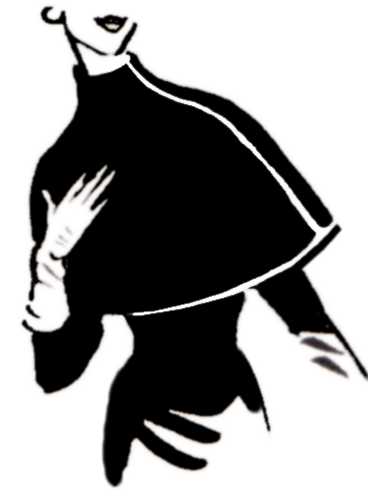
Stella McCartney
Black cashmere, wool and silk blend cape with a detachable hood at the back.


These hoods are attached by buttons.
 |
| Chemstrand Nylon 1957 (myvintagevogue.com) |
This hood is attached by a pussybow tied at the neck.
|
| Chemstrand Nylon 1957 (myvintagevogue.com) |

 |
A starched-stiff detachable wing collar from Luke Eyres. |
"A detachable collar is a shirt collar separate from the shirt, fastened to it by studs. The collar is usually made of a different fabric from the shirt, in which case it is virtually always white, and, being unattached to the shirt, can then be specially starched to a hard cardboard-like consistency." (Wikipedia)Here is a brief history of the detachable collar according to My Custom Tailor:
Mrs. Montague, tired of washing her husband´s shirts because only the collars were dirty decided one day to snip off a collar, wash it, and sew it back on. Mr. Montague, it´s written, agreed to the experiment, and in 1827, the first detachable collar was made at their home at 139 Third Street.
 |
A pair of collar studs; the longer left one is the front stud |
"The collar is attached to the shirt by a pair of studs like those shown. The shirt has a tunic collar, a short upright band of fabric with a hole at the back and one on each side at the front. The stiff collar is attached at the back before the shirt is put on (and the tie placed under the collar for a turndown collar), then the shirt is put on, after which the front stud is pushed through the collar to fasten it."
"To starch a collar, it must be rinsed in boiling water to remove any starch, then laundered as normal. After soaking in a concentrated warm starch solution, it is left until nearly dry, then ironed until hard. While ironing, the shape is added by curling, or using a collar press".(Wikipedia)


 |
| Pierre Balmain 1950s houndstooth suit |
 |
| 1950s houndstooth dress |
 |
 |
 |
| Alexander McQueen houndstooth folded jacket, $2190, net-a-porter.com |
 |
| http://www.abakhan.co.uk/acatalog/info_32818.html |
"The 1950's Cape
The cape emerged again as an updated fashion statement in the 1950s. Paris designers often favoured simplified lines and for bulky tweedy, check and mohair fabrics the easy lines of a cloak were perfect to show the fabric to perfection.
A short cape was promoted in 1955 and this example shows a picture from a magazine of 1955.


| 7 For All Mankind | |
 | HOLIDAY CAPE Chic and understated, this Herringbone Wool Cape is the perfect outerwear piece for the holiday season. The fabrication is a brushed herringbone wool that has a soft and smooth hand and offers great drap for this particular silhouette. |

 |
| Topshop |
 |
| Max Marra |
 |
| Ralph Lauren |
 |
| Rugby |
 |
| Rugby |


 |
| Town and City Tufted Cape by Susan Crawford. Image copyright Arbour House Publishing. |
"Using an unusual tufted stitch, this flattering garment is inspired by elegant capes from the 1950s. It is also reminiscent of the capes worn by nurses in the same period, and I can just remember my own mother wearing a longer early-sixties version with her uniform in the late seventies. It is a really easy knit and would be great to start now in time for the chilly days of autumn. (Yes, I know. Hard to imagine just now in the Great British Heatwave!*)It really is a very versatile pattern which will fit sizes 30-52" bust and Susan says in her pattern notes that:
"The finished length is measured from the top of the main body at the front neck and includes the garter stitch edging around the bottom of the cape. The cape is very generous and accommodating in size and shape and will fit a variety of sizes. As a result, I suggest you consider what fit you would like before choosing your size. The small will actually fit a 42 inch chest but it will fit higher and more open at the front."
The cape is knitted in a standard double knit yarn on 5mm needles and is very warm without being bulky. The tufted stitch pattern makes lots of surface area to keep you cosy without great weight. This pattern would be excellent TV knitting (whilst watching the World Cup or maybe Wimbledon at the moment?) and is a real stashbuster, using only 5 or 6 balls of the main colour and one other for contrast."